

Cutting is the thing you do most in a kitchen and the thing almost nobody is taught. It is worth an afternoon, because everything downstream gets easier: food cooks evenly, prep stops dragging, and a sharp knife handled well is safer than a blunt one handled carefully.
Set the board up first
A board that slides is a board that will eventually cut you. Wet a piece of kitchen paper, wring it out, and lay it under the board. That is the whole trick.
Give yourself space on both sides: one side for what is waiting, one for what is done. If your cut vegetables are piling up under the knife, you will start rushing to clear them, and rushing is where accidents live.
The grip
Hold the knife by pinching the blade between thumb and forefinger, just in front of the handle, with the remaining fingers wrapped around the handle. It feels odd for about ten minutes and then feels obvious. You get control from the blade rather than the handle, and your wrist stops doing work your arm should be doing.
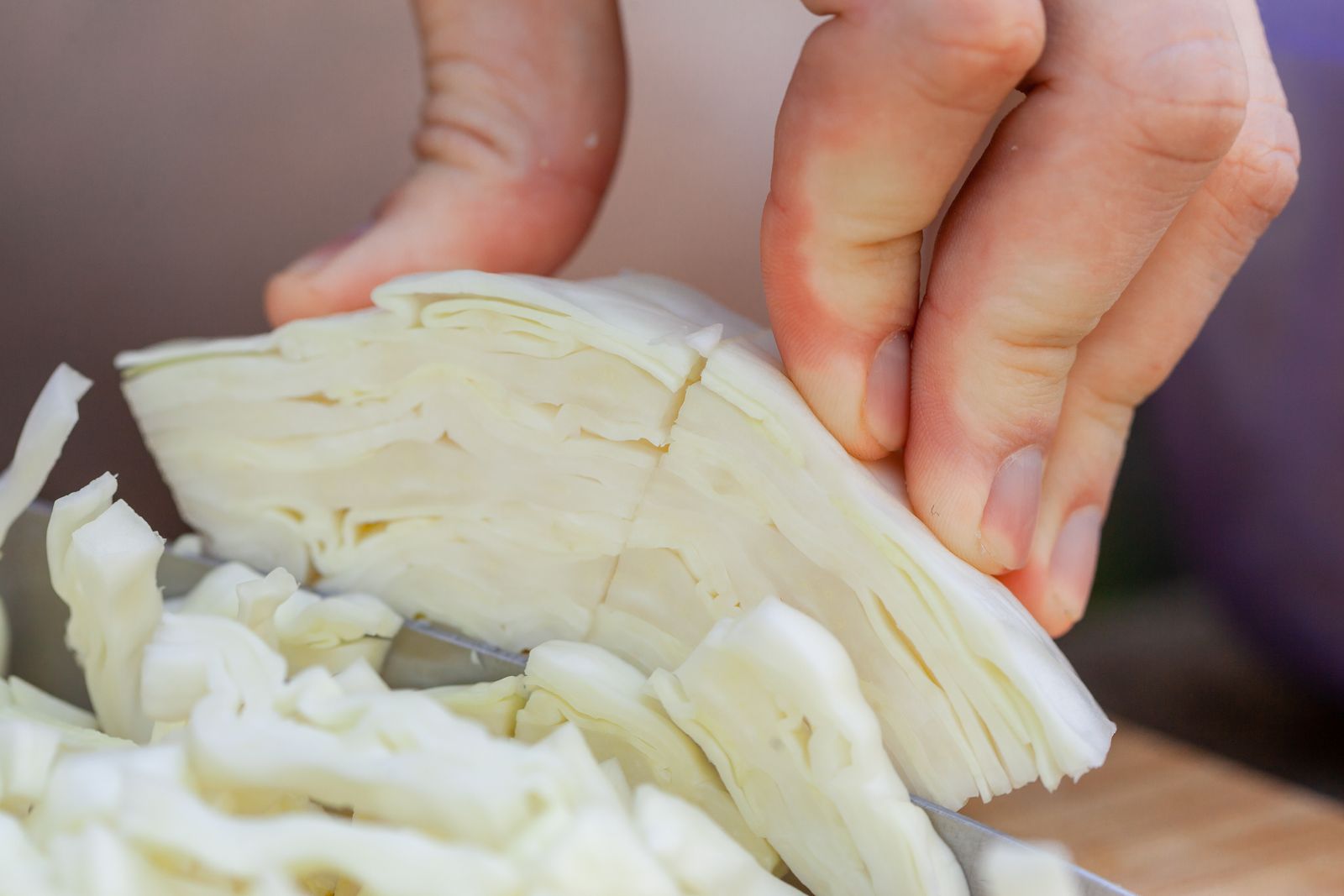
The other hand makes a claw: fingertips curled under, knuckles forward. The flat of the blade rides against those knuckles, which means the edge physically cannot reach your fingertips. Move the claw back as you cut, and the knife follows it.
The four cuts
1. The slice
Tip of the knife stays on the board, the heel lifts and comes down and forward. You are not chopping straight down; you are pushing the blade through in a shallow arc. Anything soft, anything round, anything you want to look neat: this is the cut.
2. The dice
A dice is three slices in different directions. Flatten the item first by cutting a slice off one side so it sits still. Then slice into planks, planks into sticks, sticks across into cubes. An onion is the same idea using its own layers: halve through the root, cut horizontally, then vertically, then across. Leave the root end attached and it holds itself together.
3. The rough chop
For anything heading into a pot where it will be blitzed or cooked for an hour. Speed over neatness. The one rule is roughly even size, because a pan does not know that the big pieces need longer.
4. The chiffonade
Stack leaves, roll them into a cigar, slice across thinly. Basil, mint, sage, cabbage, kale. Use a sharp knife and a light hand: crushing herbs bruises them and turns the edges black.
Even beats pretty
Nobody at the table will measure your dice. The pan will notice, though. Pieces of the same size finish at the same time, which is the entire practical reason knife skills exist. If your carrots come out in a range of sizes, cut the big ones down rather than accepting that some will be raw and some will be mush.
Sharpness is a habit, not a purchase
A dull knife slips off skins instead of biting in, and asks for pressure, which is exactly when hands slide. Two things keep an edge alive:
- A honing steel, used briefly before you start. It does not sharpen; it straightens the edge that daily use rolls over. A few passes at a shallow angle per side.
- Actual sharpening, a few times a year, on a whetstone or by someone who does it for a living. A knife that will not slice a tomato skin without pressure is telling you it is time.
Keep knives out of the dishwasher and off other metal. Wash, dry, and store on a magnetic strip or in a block. A drawer full of loose blades ruins edges and surprises hands.
One knife does most of it
A chef's knife of about twenty centimetres handles nearly everything. Add a small paring knife for the fiddly jobs and a serrated knife for bread and tomatoes, and you are done. Buy the one that feels balanced in your hand rather than the one with the best story, and spend what you saved on getting it sharpened.