



Food carries a large share of a household's environmental impact, and almost none of the effort people put into it goes where the impact actually is. That is not anyone's fault: the visible parts of food are the packaging, the shop and the journey home. The parts that matter sit further upstream.
Here is the short version of what the research broadly agrees on, and what it means at the till.
What you eat matters far more than where it came from
The most widely cited work here is a 2018 analysis in Science by Poore and Nemecek, which pulled together data from roughly 38,000 farms across dozens of countries. Its central finding has held up since: for most foods transport is a small fraction of the total footprint, and the differences between foods dwarf the differences within them.
Beef and lamb sit far above everything else, by a distance no other variable closes. Cheese and other dairy sit in the middle. Chicken, eggs and farmed fish are lower again. Pulses, grains and most vegetables are at the bottom, by an order of magnitude.
Which means a locally reared, carefully farmed beef dinner still carries a much larger footprint than beans that travelled a long way. That is an uncomfortable conclusion if you have been buying local meat as your environmental choice, but it is the clearest signal in the data.
The bin is the biggest lever in most kitchens
Food thrown away carries every cost of producing it and adds the cost of disposing of it. Household waste is a substantial share of total food waste in wealthy countries, and unlike farming methods it is entirely within your control.
The habits that move it: shop with a list and a rough plan, keep an "eat me first" shelf in the fridge, learn what your storage actually does, understand that best before is about quality while use by is about safety, and freeze things before they turn rather than after you have decided to be optimistic about them.
Food miles are usually a rounding error, with one exception
Shipping is remarkably efficient per kilo. A container of rice crossing an ocean adds very little per portion. The exception is air freight, used for a narrow set of highly perishable, high-value goods: some out-of-season berries, fresh asparagus from another continent, certain fish. Those carry a genuinely large transport footprint.
The practical rule: if it is fresh, delicate and available thousands of miles out of season, it probably flew. Everything else came by ship or lorry and the mileage barely registers.
Seasonal is a better guide than local
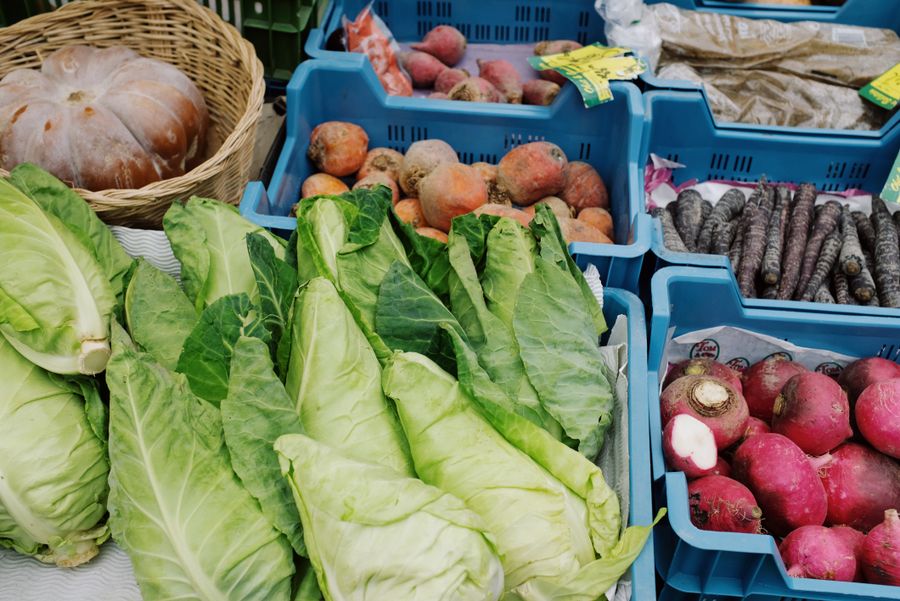
Local food grown in a heated greenhouse in February can carry a higher footprint than the same crop grown in the sun elsewhere and trucked in. What seasonal eating reliably does is point you at field-grown produce, which is cheaper, better and lower impact at the same time. That alignment is why it is worth building a kitchen around, and it is why this site has a seasonal calendar rather than a carbon calculator.
Packaging is a smaller climate story than it looks
Packaging is usually a small share of a food's footprint, and it sometimes earns its keep by preventing waste: a wrapped cucumber lasts considerably longer than a naked one. Plastic is a real problem, but mostly a pollution and litter problem rather than a climate one. Treat them as two separate questions instead of letting one stand in for the other.
Fish needs a different lens
Fish is not one thing. The species, the fishery, the method and the state of the stock matter more than any general rule about seafood. Small oily fish from well-managed stocks are among the better choices available; some farmed and trawled species are among the worst. A current ratings guide from a marine conservation body is more useful than anything you can memorise.
The short list
- Move some meals from beef and lamb towards pulses, chicken or fish. The largest single change available in most diets, and it does not require giving anything up permanently.
- Throw less away. Cheaper, easier, and roughly as effective for most households.
- Eat what is in season where you live. Better food, less money, lower impact.
- Skip the air-freighted few. Out-of-season soft fruit is the usual suspect.
- Stop agonising over bags and packaging. Not nothing, but not where the weight is.
None of this requires a perfect diet. Shifting a few meals a week is a real change, and it is the kind that lasts.